Your Task List Is Lying to You
Linda Clark
•
Jan 9, 2026

Your Task List Is Lying to You
Chasing Competence and Control Through Operational Work
You know that feeling when you've been productive all day. Inbox at zero. Tasks checked off. Meetings attended. Work done.
And yet you still feel like you accomplished nothing that actually mattered.
That's not imposter syndrome. And it's not because the work wasn't necessary.
It's because operational work and strategic work are not the same thing.
Your task list is full of legitimate work. Work that needs doing. Work that matters to someone. Work that makes you feel competent and in control.
And that's exactly why it's so dangerous.
The Seduction of What's in Front of You
The work on your task list is legitimate. Responding to that email. Solving that team problem. Updating that report. Attending that meeting. All of it matters.
But here's what makes it seductive. Operational work has clear edges. You know when it's done. You can check a box. You can see progress. You feel competent doing it because you know how.
Strategic work doesn't offer any of that.
Strategic work is uncomfortable. It doesn't have clear steps. There's no checkbox. You can't delegate it to your calendar or hide it in a Slack thread. Strategic work asks you to sit with ambiguity, make decisions without all the data, and take responsibility for shaping the future instead of just responding to the present.
So what do we do. We reach for the task list. We find seventeen emails that need responses. We schedule another meeting. We reorganize the project tracker. We do legitimate work that feels productive and keeps us safely away from the harder question.
What are we actually building here.
The task list becomes our excuse for why we don't have time to think.
The Conscious Dodge vs. The Unconscious Drift
There are two ways leaders trade strategic time for operational work, and both are dangerous.
The Conscious Dodge is when you know exactly what you're doing. You see the strategic work on your calendar. Q2 planning. Vision alignment. Culture strategy. And you let something else take priority. An urgent email. A team crisis. A meeting that "just came up." You're actively choosing the task list over the strategic work because the task list feels safer, more concrete, more immediately rewarding.
The Unconscious Drift is sneakier. You genuinely believe you're being strategic. You're working on "important" things. But if you zoom out, you'll see you're still just reacting, optimizing, managing. You're not shaping anything. You're not asking the hard questions. You're not creating the conditions for trust, innovation, or momentum. You're just keeping the machine running and calling it leadership.
Both are forms of avoidance. Both keep you stuck in the weeds. And both cost you and your team more than you realize.
What Strategic Time Actually Looks Like (And Why It's Harder Than Operational Work)
Strategic time isn't about adding another meeting to your calendar labeled "strategy session." It's about protecting space for the kind of thinking that doesn't fit neatly into task management software.
Strategic time is asking questions no one else is asking. What are we optimizing for. What are we not seeing. What would have to be true for this to work.
Strategic time is sitting with ambiguity. Not rushing to solutions. Not filling the silence with action items. Letting patterns emerge.
Strategic time is making decisions that shape culture, not just operations. What are we saying yes to. What are we saying no to. What conditions are we creating for trust and innovation.
Strategic time is protecting the future from the tyranny of the urgent. Saying no to good opportunities so you can say yes to the right ones.
This kind of thinking doesn't produce immediate, visible results. It doesn't check a box. It doesn't feel as satisfying as clearing your inbox or finishing a report.
And that's exactly why operational work wins. Every single time.
The Cost of Choosing Operational Work Over Strategic Work
When you trade strategic time for operational work, here's what you lose.
1. Clarity. You're so busy responding to what's in front of you that you lose sight of where you're actually going. Your team feels it too. They're working hard but don't know why or toward what.
2. Innovation. Strategic thinking is where new ideas live. When you're stuck in execution mode, you're optimizing the system you have, not imagining the system you need.
3. Trust. When leaders are perpetually reactive, teams lose confidence. They start to wonder if anyone is steering the ship or if everyone's just bailing water.
4. Energy. Operational work is exhausting in a way that strategic work isn't. Task lists drain you. Vision energizes you. But you have to protect the space for it.
5. Legacy. At the end of the day, no one remembers the leader who had the cleanest inbox. They remember the leader who saw what was possible and made it real.
How to Protect Strategic Time When Operational Work Never Stops
If you're ready to stop letting your task list run your leadership, here's where to start.
1. Name the Pattern Get honest with yourself. Are you consciously choosing operational work over strategic work, or are you drifting unconsciously. Either way, you can't change what you won't name.
2. Audit Your Calendar Look at the last two weeks. How much time did you spend reacting vs. shaping. If the answer makes you uncomfortable, good. That's data.
3. Protect Strategic Time Like It's Sacred Block it. Defend it. Treat it like your most important meeting because it is. And no, "thinking time" doesn't count if you spend it scrolling Slack or answering emails.
4. Start Small Pick one strategic question and sit with it for 30 minutes. No task list. No distractions. Just you and the question. It will feel uncomfortable. That's how you know it's working.
5. Automate the Obvious Decision fatigue is real. Automate, delegate, or delete anything that doesn't require your strategic brain. Your task list should serve your leadership, not replace it.
6. Build Strategic Rituals Make strategic thinking a habit, not a luxury. Weekly reflection. Monthly vision check-ins. Quarterly deep dives. Rituals create the conditions for clarity.
The Invitation
Your task list will always be full. There will always be more emails, more meetings, more fires to put out. All of it legitimate. All of it necessary.
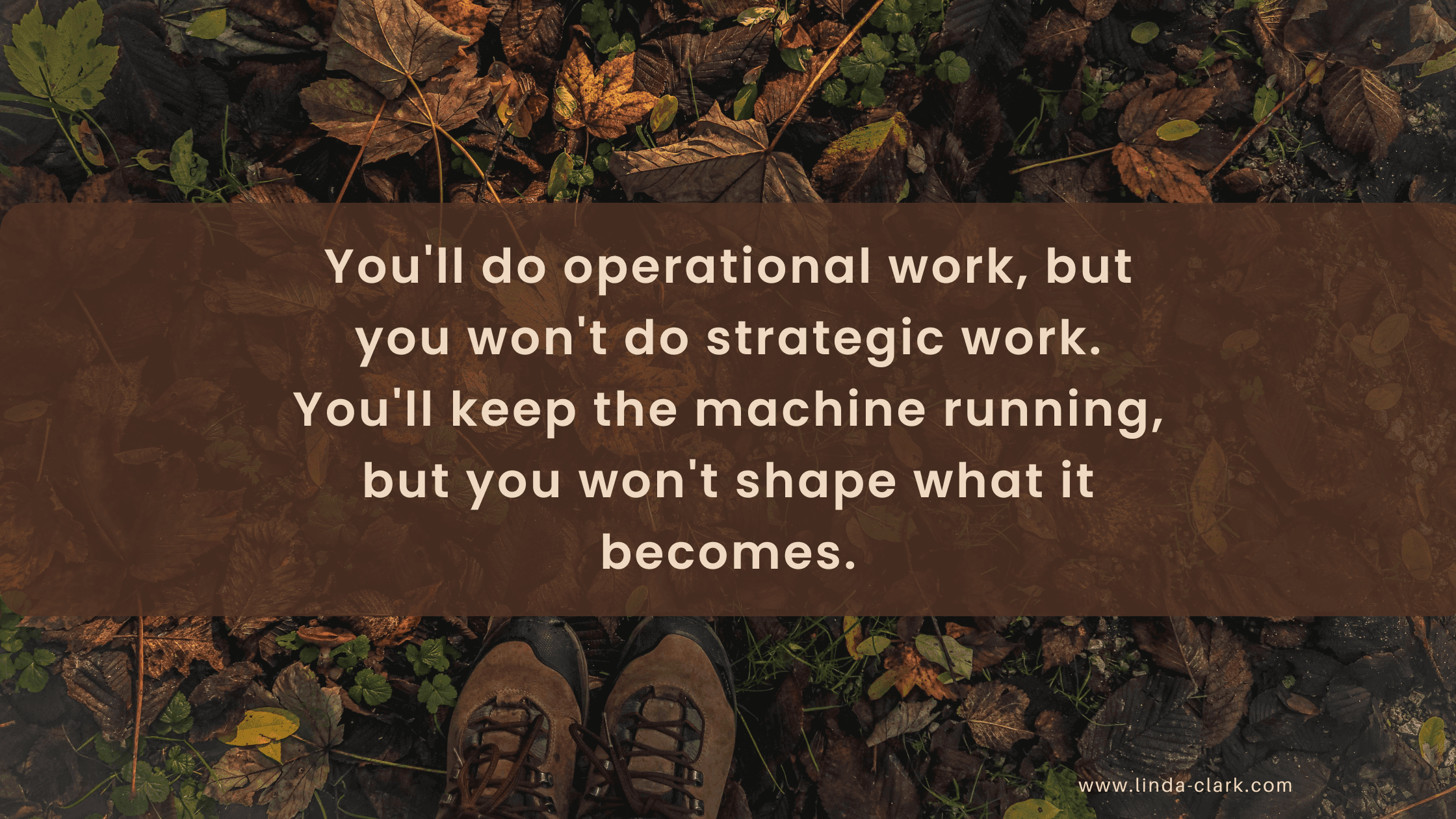
But if you let the task list dictate your time, you'll spend your entire career managing instead of leading. You'll do operational work, but you won't do strategic work. You'll keep the machine running, but you won't shape what it becomes.
Strategic thinking isn't a luxury. It's not something you do when you have time. It's the work.
And the only person who can protect that time is you.
So here's the question. What are you choosing by staying in operational work.
And more importantly. What becomes possible when you make space for strategic work.
Ready to stop letting operational work crowd out strategic work. Let's talk about how to build the systems, rituals, and mindset shifts that turn reactive leaders into strategic guides. Book a call and let's get you out of the weeds and into the work that shapes the future.
Your Task List Is Lying to You
Chasing Competence and Control Through Operational Work
You know that feeling when you've been productive all day. Inbox at zero. Tasks checked off. Meetings attended. Work done.
And yet you still feel like you accomplished nothing that actually mattered.
That's not imposter syndrome. And it's not because the work wasn't necessary.
It's because operational work and strategic work are not the same thing.
Your task list is full of legitimate work. Work that needs doing. Work that matters to someone. Work that makes you feel competent and in control.
And that's exactly why it's so dangerous.
The Seduction of What's in Front of You
The work on your task list is legitimate. Responding to that email. Solving that team problem. Updating that report. Attending that meeting. All of it matters.
But here's what makes it seductive. Operational work has clear edges. You know when it's done. You can check a box. You can see progress. You feel competent doing it because you know how.
Strategic work doesn't offer any of that.
Strategic work is uncomfortable. It doesn't have clear steps. There's no checkbox. You can't delegate it to your calendar or hide it in a Slack thread. Strategic work asks you to sit with ambiguity, make decisions without all the data, and take responsibility for shaping the future instead of just responding to the present.
So what do we do. We reach for the task list. We find seventeen emails that need responses. We schedule another meeting. We reorganize the project tracker. We do legitimate work that feels productive and keeps us safely away from the harder question.
What are we actually building here.
The task list becomes our excuse for why we don't have time to think.
The Conscious Dodge vs. The Unconscious Drift
There are two ways leaders trade strategic time for operational work, and both are dangerous.
The Conscious Dodge is when you know exactly what you're doing. You see the strategic work on your calendar. Q2 planning. Vision alignment. Culture strategy. And you let something else take priority. An urgent email. A team crisis. A meeting that "just came up." You're actively choosing the task list over the strategic work because the task list feels safer, more concrete, more immediately rewarding.
The Unconscious Drift is sneakier. You genuinely believe you're being strategic. You're working on "important" things. But if you zoom out, you'll see you're still just reacting, optimizing, managing. You're not shaping anything. You're not asking the hard questions. You're not creating the conditions for trust, innovation, or momentum. You're just keeping the machine running and calling it leadership.
Both are forms of avoidance. Both keep you stuck in the weeds. And both cost you and your team more than you realize.
What Strategic Time Actually Looks Like (And Why It's Harder Than Operational Work)
Strategic time isn't about adding another meeting to your calendar labeled "strategy session." It's about protecting space for the kind of thinking that doesn't fit neatly into task management software.
Strategic time is asking questions no one else is asking. What are we optimizing for. What are we not seeing. What would have to be true for this to work.
Strategic time is sitting with ambiguity. Not rushing to solutions. Not filling the silence with action items. Letting patterns emerge.
Strategic time is making decisions that shape culture, not just operations. What are we saying yes to. What are we saying no to. What conditions are we creating for trust and innovation.
Strategic time is protecting the future from the tyranny of the urgent. Saying no to good opportunities so you can say yes to the right ones.
This kind of thinking doesn't produce immediate, visible results. It doesn't check a box. It doesn't feel as satisfying as clearing your inbox or finishing a report.
And that's exactly why operational work wins. Every single time.
The Cost of Choosing Operational Work Over Strategic Work
When you trade strategic time for operational work, here's what you lose.
1. Clarity. You're so busy responding to what's in front of you that you lose sight of where you're actually going. Your team feels it too. They're working hard but don't know why or toward what.
2. Innovation. Strategic thinking is where new ideas live. When you're stuck in execution mode, you're optimizing the system you have, not imagining the system you need.
3. Trust. When leaders are perpetually reactive, teams lose confidence. They start to wonder if anyone is steering the ship or if everyone's just bailing water.
4. Energy. Operational work is exhausting in a way that strategic work isn't. Task lists drain you. Vision energizes you. But you have to protect the space for it.
5. Legacy. At the end of the day, no one remembers the leader who had the cleanest inbox. They remember the leader who saw what was possible and made it real.
How to Protect Strategic Time When Operational Work Never Stops
If you're ready to stop letting your task list run your leadership, here's where to start.
1. Name the Pattern Get honest with yourself. Are you consciously choosing operational work over strategic work, or are you drifting unconsciously. Either way, you can't change what you won't name.
2. Audit Your Calendar Look at the last two weeks. How much time did you spend reacting vs. shaping. If the answer makes you uncomfortable, good. That's data.
3. Protect Strategic Time Like It's Sacred Block it. Defend it. Treat it like your most important meeting because it is. And no, "thinking time" doesn't count if you spend it scrolling Slack or answering emails.
4. Start Small Pick one strategic question and sit with it for 30 minutes. No task list. No distractions. Just you and the question. It will feel uncomfortable. That's how you know it's working.
5. Automate the Obvious Decision fatigue is real. Automate, delegate, or delete anything that doesn't require your strategic brain. Your task list should serve your leadership, not replace it.
6. Build Strategic Rituals Make strategic thinking a habit, not a luxury. Weekly reflection. Monthly vision check-ins. Quarterly deep dives. Rituals create the conditions for clarity.
The Invitation
Your task list will always be full. There will always be more emails, more meetings, more fires to put out. All of it legitimate. All of it necessary.
But if you let the task list dictate your time, you'll spend your entire career managing instead of leading. You'll do operational work, but you won't do strategic work. You'll keep the machine running, but you won't shape what it becomes.
Strategic thinking isn't a luxury. It's not something you do when you have time. It's the work.
And the only person who can protect that time is you.
So here's the question. What are you choosing by staying in operational work.
And more importantly. What becomes possible when you make space for strategic work.
Ready to stop letting operational work crowd out strategic work. Let's talk about how to build the systems, rituals, and mindset shifts that turn reactive leaders into strategic guides. Book a call and let's get you out of the weeds and into the work that shapes the future.
Categories
Strategic Decision-Making, Executive Leadership
Tags
strategic decision making, executive leadership, leadership presence, organizational development

Related Blog


IMAGINE A GUIDE WITH YOU
Get The Field Notes
Field-tested ideas for leaders and teams who want more trust, less noise, and
the best version of success.
IMAGINE A GUIDE WITH YOU
Get The Field Notes
Field-tested ideas for leaders and teams who want more trust, less noise, and
the best version of success.
IMAGINE A GUIDE WITH YOU
Get The Field Notes
Field-tested ideas for leaders and teams who want more trust, less noise, and
the best version of success.